
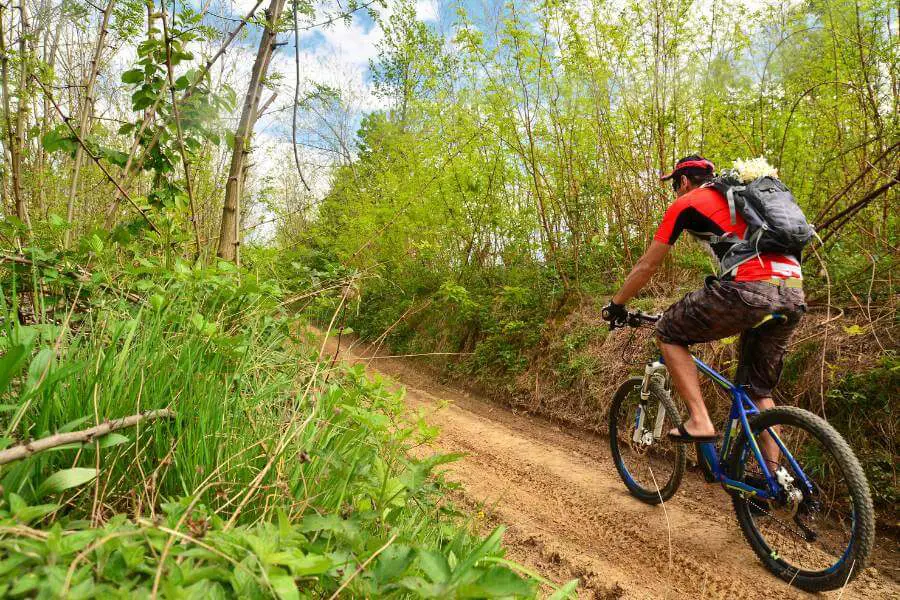
If you’re a fan of mountain biking and you want to see more of the world, touring is the way to do it.
Taking your mountain bike on the road may be a fantastic experience in and of itself or a welcome change from all the mud and sludge.
In this post, I’ll go over several key reasons why they function effectively as well as some factors that make them less effective.
Therefore, you should definitely pay attention if you intend to ride your mountain bike on a lengthy cycling journey.
Table of Contents
Is a Mountain Bike Good for Touring?
Mountain bikes are suitable for touring, indeed.
Mountain bikes are built to go over rough terrain, but they may also be used for long-distance travel.
The MBT is strong and capable of navigating even the most difficult routes; professional riders even like these bikes.
A mountain bike demands a little bit more pedaling than a road cycle, but by adding the proper handlebar and tires, you can guarantee a long, comfortable ride.
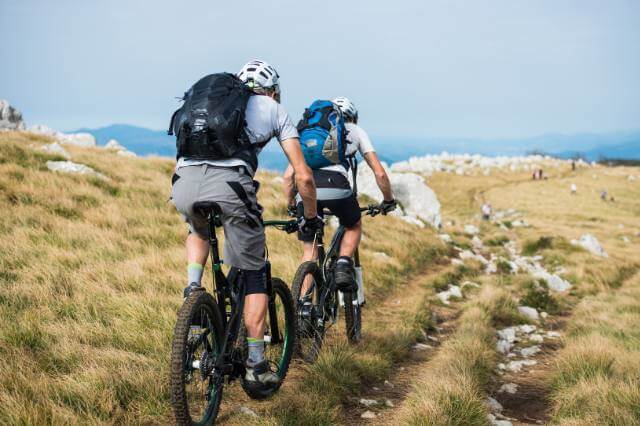
Advantages of Mountain Biking for Touring
The Comfort of an MTB
In comparison to touring bicycle tires, mountain bike tires are broader and comfier.
As you drive through uneven or bumpy terrain, these tire types serve to soothe the ride.
This is the best option for people with delicate body parts who can’t stand the torture of being shaken all day.
For individuals who desire to go farther distances, it is also useful.
A Mountain Bike Weighs Less Than an Equivalent Touring Bike
It will be simpler to pedal and carry your bicycle up and down slopes if it is lighter.
As a result, traveling will need less energy, which is what tourism is all about.
Those who wish to go touring will find that owning a mountain bike allows them to go faster without carrying as much weight.
They Have a Lower Risk of Getting a Flat Tire
A mountain bike’s tire design is very different from an everyday bicycle’s.
Wider, knobbier tires, which are less prone to sustain damage or punctures, are more common on mountain bikes.
This is excellent for anyone who will be walking in a forest or climbing a mountain.
They Are Powerful
A mountain bike is a fantastic option for anyone interested in rugged travel because they are made to withstand abuse.
A mountain bike is the best choice for anyone who intends to carry a lot of weight over rocks, bumps, and through the forest due to its strong design.
A tough mountain bike would perform better in those conditions than a touring bike.
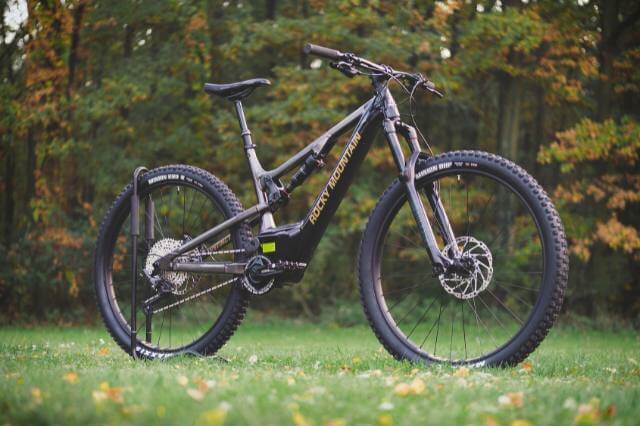
They Are Adaptable
An MTB may be transformed into anything you need it to be, which is the ideal feature of utilizing one for traveling.
The racks and panniers seen on most MTBs are the clearest illustration of this; they can be readily replaced with heavier equipment when necessary and taken off when not.
This provides you the freedom to use your bike whenever you choose for both regular transportation and tourism.
MTBs Are Able to Cover Long Distances
Long distances will be easier for touring cyclists to handle thanks to the mountain bike’s tires and gears.
While the robust design is good, the gearing system is more appropriate for extended touring trips.
You may change your pedaling effort to match the terrain you are currently traveling over without stopping if your bike has a broader range of gears.
This is perfect if you’re pressed for time or want to breeze through the next hill with little effort.
For someone who wants their bicycle to survive longer, the gears are also more resilient than those found on the majority of touring bikes.
They’re Less Expensive Than Touring Bikes
For a variety of reasons, this is true.
First off, since they lack many of the qualities that make touring bicycles so important, mountain bikes are often less expensive than most touring bicycles.
While certainly not true for all models, the majority of mountain bikes are less expensive than the majority of touring bicycles.
Additionally, following the first purchase, they may be simply updated to offer the same capabilities as a touring bicycle.
This is a fantastic way to reduce the cost of your equipment while still using it for both tasks.
Please note, though, that while the majority of MTBs won’t cost as much as a high-end touring bike, none of them can match the top models made by designers and engineers with an in-depth understanding of the industry.
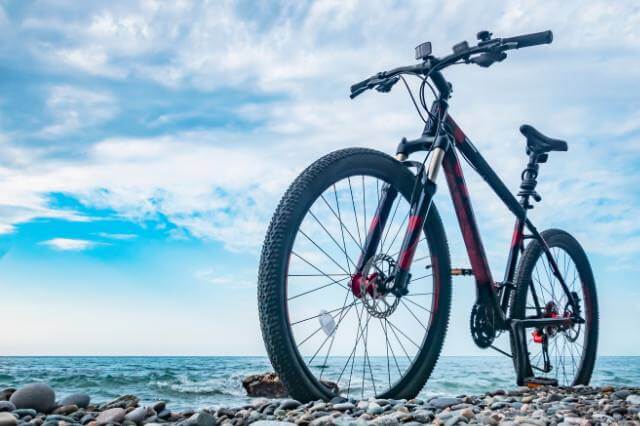
Finding Aftermarket Components Built Especially for MTBs Is Simple
Touring bicycles are excellent, but compared to mountain bikes, they are more difficult to locate aftermarket components for.
After all, there are many different kinds of MTBs available, and each one is made for a certain kind of terrain.
This implies that if you possess an MTB rather than a touring bicycle, after-market components will frequently be simpler to get.
The explanation is simple: mountain bikes are utilized in comparable environments all over the world.
Because there are more of these bikes available on the market, there is a bigger need for aftermarket components for them.
Cons of Touring on a Mountain Bike
A mountain bike has several features that make it perfect for traveling, but they also have numerous drawbacks that you might not want to deal with.
First, due to compatibility concerns with disc brakes and attaching rear bike racks, certain mountain bike frames aren’t designed to hold all the gear you would wish to carry.
A mountain bike’s aluminum frame is also not as strong as a bike with a steel frame.
Full-suspension mountain bikes are also a terrible decision because they are substantially heavier than conventional mountain bikes.
The fact that mountain bike tires are made for off-road riding and have reduced rolling economy is another problem.
Accordingly, depending on the kind of routes you intend to go, touring with the stock tires may not be a great idea.
The good news is that you may replace the tires with hybrid-style tires on journeys you are aware will entail pavements, much as I do.
You also won’t be able to carry as much gear on a mountain bike as you would on another kind of bike.
For instance, they don’t have as many water bottle mounting options or places.
Finally, since an MTB has a flat handlebar, you won’t have as many options for hand placements.
As a result, you can have regular arm tiredness during your long-distance journey.
Things to Consider When Choosing a Touring MTB
Wheels
Your bike’s overall handling will be enhanced with a better wheel.
In terms of weight, rigidity, and rim width, a new set of wheels will enhance how your bike responds to various obstacles and terrain when traveling.
For optimum performance, MTB touring wheels should be compact and durable enough to withstand heavy use.
36-spoke wheels are sometimes a better option if you plan to ride on difficult routes or carry a lot of weight.
Smaller 650b or 26-inch wheels could be the best option if you’re planning a long-distance journey that will take you over dirt and into remote regions because the tires you can mount on them often give superior grip and bump absorption.
Frame Material
The frame is one of the most important aspects to take into account when selecting the best mountain bike for you.
The most common materials are carbon, steel, titanium, and aluminum.
Each one has a unique set of traits, advantages, and disadvantages.
If you’re looking for a tastefully retro alternative that takes you back to the heyday of mountain riding, steel is your best chance.
While titanium frames are the most costly, aluminum alloy frames are the cheapest.
While it’s still an expensive alternative, carbon fiber is the perfect compromise since it doesn’t give up on any fronts, and it’s growing less expensive.
You may ultimately select the choice that best satisfies your demands.
Gears
You’ll ride quicker and have more fun if you select the right gear ratio.
You have to be aware of the best gearing for your riding style.
The outcome of your choice will immediately affect how well you and your bike operate.
Most tourers will discover that their demands may be met by a 3x crankset with a 9 or 10-speed cassette.
Brakes
Brakes are equally as important as wheels while you’re pedaling your bike hard.
You’ll need great brakes on your bike to stop quickly. If you want to ride your bike with confidence, you must have a solid set of disk brakes.
These are trustworthy, easy to maintain, lightweight, and most importantly, affordable.
Two of the best brakes on the market are made by Shimano and Magura.
For those who love linear de-acceleration, SRAM Guide and TRP Quadeim are two fascinating possibilities to take into account.
Choosing the finest saddle is essential since it has the most impact on riding comfort.
Riders come in a variety of sizes and forms, so they should be tailored to your unique demands.
Your body type will have a direct influence on your performance when it comes to saddle comfort.
If you wish to ride your bike for hours in comfort, you need to think about the saddle’s length, form, cushioning, and ergonomic curves.
Saddles with a lot of padding should be avoided since they won’t support you effectively when the foam or padding material starts to deform over time under strain.
Suspension
The two forms of suspension available on MTBs are Full Suspension (Front and Rear) and Front Suspension Only (also known as Hardtail).
Full-suspension bikes can tackle rougher routes with roots, rocks, and drops.
Contrarily, hardtail bikes are designed for smoother single tracks, paved roads, and doubletrack.
Each of these bicycles has a particular use.
Long rides on challenging roads and riders with back or joint issues should use full-suspension bikes.
Hardtail bikes are best suited for asphalt and easy trails, while they can handle challenging terrain.
It’s also important to note that these bikes are fantastic at climbing hills. The choice of which bike best meets your needs is ultimately up to you.
Weight
The appropriate bike selection is crucial when traveling.
People often choose a bike with a steel frame for touring because of its strength and ability to ride smoothly.
Bike frames made of steel, which are a little heavier than those made of aluminum or titanium, are better for touring, as was previously said.
However, because we are talking about mountain bikes for touring on this subject, we also need to take into account that many prefer lighter bikes.
Nothing about that is fundamentally bad.
Since they are very simple to ride, light bikes allow you to travel further, which is only possible if they are light.
Therefore, the choice of bike is ultimately yours to make. Typically, a trail bike weighs 13.5 kilograms (19.7 pounds).
How Far Can You Ride on a Mountain Bike?
In actuality, there is no set limit to how far a mountain bike may travel.
You may adapt it to be appropriate for a long-distance journey by making a few changes.
For reduced rolling resistance, one of these is raising tire pressure.
For usage on flat roads, MTBs’ standard tires must be replaced with slicker ones.
Choose a stem riser for your hands’ comfort; this will place you in a more upright position similar to a hybrid bike.
Locking out the fork will guarantee that you don’t waste all of your energy on suspension if you anticipate no hills or climbs along the way.
A paneer rack may be added so you won’t have to lift the weight yourself.
All of these will make sure that you always have a comfortable memory of a lengthy mountain bike ride.
It is essential to train a lot on your mountain bike in order to build up your muscles and prepare for stiffness and cramps before embarking on a lengthy ride.
Final Thoughts
Road touring is a good fit for mountain bikes.
You’ll need to have the appropriate equipment when riding a mountain bike on open roads.
Follow the advice above, notably the recommendation to convert to platform pedals for greater mobility and hybrid tires.
If your mountain bike has an aluminum frame, stick to softer terrain and invest in fenders because your equipment will inevitably become muddy at some time.
When you embark on a long ride, it is a good idea to bring water and snacks along with you in addition to your other food supplies.
In this manner, you may still quickly stop for a snack or drink while cycling.
Survive but not least, ensure sure you have a mechanism to keep your phone charged or that you have a phone that can last the whole of your journey.
Overall, it is safe to say that using a mountain bike for cycling trips is acceptable.
Further Reading: